How to Choose the Right Weight for Strength Training
Nov 1, 2026
by Christopher windbigler
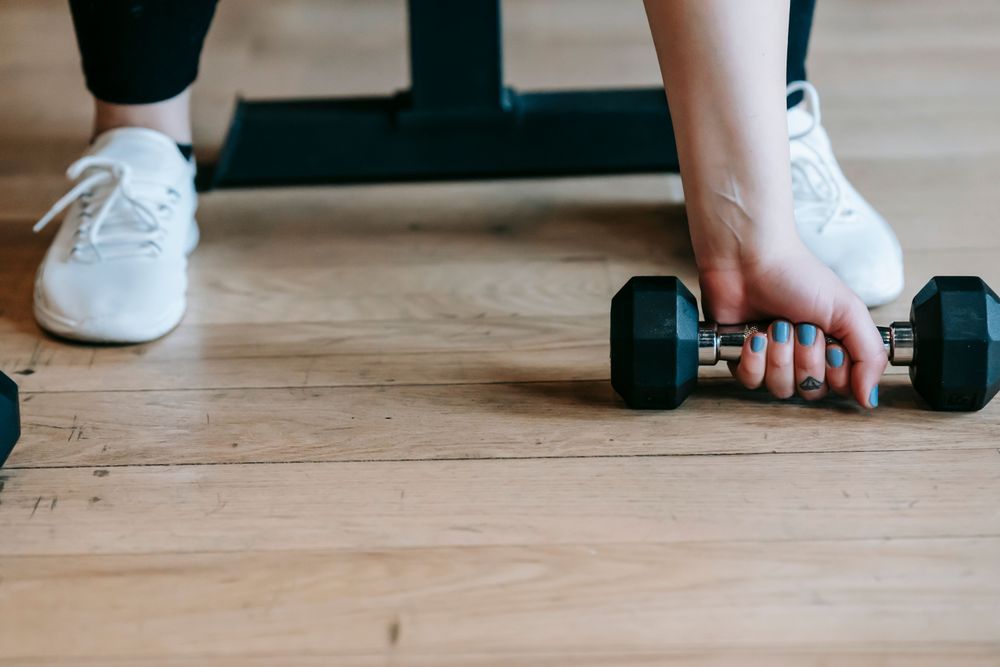
You walk up to the dumbbell rack, see weights ranging from 5 to 50 pounds, and immediately face a question.
Which one should you choose?
The right weight for strength training is one that challenges your muscles while allowing you to complete your planned repetitions with good control and technique.
If the weight feels effortless, you may need more resistance. If you cannot maintain your technique, it may be too heavy for your current ability.
The right choice also depends on the exercise, your experience, and your training goals.
At Bare Fitness in Elkhart, Personal Training includes individualized workout planning and form coaching. That makes choosing appropriate resistance part of a broader training process rather than a guessing game.
Why Choosing the Right Weight Matters
Strength training works by challenging your muscles to perform against resistance.
That resistance can come from dumbbells, kettlebells, machines, resistance bands, or your own body weight.
According to the American College of Sports Medicine, resistance training programs should be individualized according to goals, ability, and safety. Different loading strategies can improve strength and other aspects of muscular fitness.
The important point is that heavier does not always mean better.
A beginner learning a new movement may benefit from lighter resistance while developing coordination and control.
An experienced lifter performing a familiar exercise may need more resistance to create an appropriate challenge.
Your goal is to find the weight that makes sense for the exercise you are performing today.
💪 Three Signs You Have Chosen the Right Weight
You do not need advanced equipment to make an initial assessment.
Pay attention to these three things.
1. Your first repetitions feel controlled
You should be able to begin the exercise without swinging, jerking, or using momentum to move the weight.
For example, during a dumbbell row, your torso should remain appropriately supported or controlled rather than twisting dramatically to lift the dumbbell.
2. The final repetitions feel more challenging
If your plan calls for ten repetitions, the last few should generally require more effort than the first few.
However, challenging does not mean losing control or experiencing sharp pain.
3. You could complete a small number of additional repetitions
For many healthy beginners, finishing a set while feeling that another two or three controlled repetitions might have been possible is a reasonable starting strategy.
This is a practical coaching method, not a universal requirement.
Experienced lifters may use different effort targets depending on their goals.
A Simple Test for Choosing Your Starting Weight
Here is a practical method you can use with an exercise you already know how to perform.
Step 1: Choose a manageable weight
Begin with resistance that allows you to practice the movement confidently.
If you have never performed the exercise, learn the movement before increasing resistance.
Step 2: Select a repetition target
For this example, imagine your workout calls for ten repetitions.
The exact target should come from your program rather than being the same for every exercise.
Step 3: Complete the repetitions with control
Pay attention to your posture, movement, and effort.
Do not rush simply to finish the set.
Step 4: Evaluate the difficulty
Ask yourself:
Did the weight feel easy throughout?
Did the last few repetitions require noticeable effort?
Did I maintain control?
Could I have completed a few more repetitions?
Step 5: Adjust if needed
Use this simple guide.
| What you notice | What to consider |
|---|---|
| Ten repetitions feel extremely easy | Try slightly more resistance next time |
| Ten repetitions are challenging but controlled | The weight may be appropriate |
| Technique deteriorates before ten repetitions | Reduce resistance or reassess the movement |
| You experience sharp or unusual pain | Stop and seek appropriate guidance |
This method helps you make decisions based on performance rather than comparing yourself with someone else.
Why the Same Weight Does Not Work for Every Exercise
Imagine performing a squat, shoulder raise, and dumbbell row.
Each exercise involves different muscles, movement patterns, and demands.
A weight that feels manageable during a squat might be far too challenging for a shoulder raise.
That is normal.
You should also expect differences between your upper and lower body, between familiar and unfamiliar exercises, and between exercises performed with different equipment.
Instead of deciding that you are a person who uses 15-pound dumbbells, think about the resistance that makes sense for each movement.
At Bare Fitness, individualized Personal Training can help you evaluate those differences while receiving direct feedback on technique.
🏋️ When Should You Increase the Weight?
Once a weight becomes easier, you may wonder whether it is time to move up.
Increasing resistance is one form of progressive overload, which means gradually adjusting training demands as your abilities develop.
The ACSM resistance training position stand explains that progression can involve changes to resistance, training volume, exercise selection, and other variables.
You do not necessarily need to increase weight every week.
Consider increasing resistance when:
-
You consistently complete your planned repetitions.
-
Your technique remains controlled.
-
You finish your sets with more capacity than your program intends.
-
You have recovered adequately between sessions.
-
The next available weight is an appropriate increase.
A practical example
Imagine you are performing dumbbell rows with 15 pounds.
During your first session, ten repetitions feel challenging.
After several sessions, the same ten repetitions feel noticeably easier.
You may be ready to try a slightly heavier dumbbell.
If the next weight is too difficult, you could continue with the current resistance while improving your repetitions, control, or overall training volume.
Progress does not have to happen through heavier weights alone.
What If You Are Afraid of Lifting Too Heavy?
It is reasonable to feel uncertain when starting resistance training.
You may be worried about technique, discomfort, or choosing a weight beyond your current ability.
The solution is not necessarily avoiding challenging exercise forever.
It is learning how to progress appropriately.
Start with movements you can control, use manageable resistance, and build experience before attempting more demanding variations.
For someone returning after years without structured exercise, even body weight movements may provide a meaningful challenge.
The CDC recommends muscle strengthening activity on at least two days per week for adults. Those activities can be adapted to different abilities and do not require advanced weightlifting.
If you have an unresolved injury, significant pain, or a medical condition that affects exercise, seek appropriate professional guidance before substantially increasing your training demands.
Common Mistakes That Make Weight Selection Harder
Copying someone else's dumbbells
The person next to you may have years of training experience.
Their weight selection tells you very little about what is appropriate for your body.
Choosing the heaviest weight you can move once
Moving a weight once does not necessarily mean you can use it appropriately for an entire workout.
Increasing weight before learning technique
More resistance can make an unfamiliar movement harder to control.
Learn the movement first.
Never changing the challenge
If your workouts remain effortless for months, your program may need an adjustment.
That adjustment could involve resistance, repetitions, sets, or exercise difficulty.
Assuming soreness means the workout worked
Muscle soreness is not a reliable scorecard for training quality.
Track your performance, technique, and progress instead.
Your Weight Selection Checklist ✅
Before your next strength workout, ask yourself:
-
Do I understand how to perform this exercise?
-
Can I move the weight without unnecessary momentum?
-
Does the resistance match my planned repetitions?
-
Are the final repetitions appropriately challenging?
-
Can I maintain control throughout the set?
-
Am I progressing based on performance rather than comparison?
-
Do I know when to ask for coaching or adjust the exercise?
If you can answer these questions confidently, you are making a more informed training decision.
How Coaching Helps You Progress
Choosing a weight is only one part of effective strength training.
A complete program also considers exercise selection, movement quality, frequency, recovery, and progression.
Bare Fitness offers individualized personal training in Elkhart, including focused 30-minute sessions and comprehensive 60-minute sessions.
Its verified service includes private coaching, individualized workout planning, and form guidance.
For beginners, that can mean learning how to select appropriate resistance without feeling pressured to lift heavier than they are ready for.
For experienced members, coaching can help refine progression and identify when a different training challenge may be more appropriate.
Frequently Asked Questions
Should beginners start with 5 or 10 pound dumbbells?
There is no universal starting weight. Five pounds may be challenging for one exercise and too light for another. Choose resistance based on your current ability, movement control, and planned repetitions.
Should every set use the same weight?
Not necessarily. Some programs use the same resistance across sets, while others adjust the load. Fatigue, exercise goals, and the structure of your workout can influence that decision.
Do I need to lift until I cannot complete another repetition?
No. The 2026 ACSM guidance indicates that training to momentary muscle failure is not consistently necessary for the average healthy adult to obtain meaningful resistance training benefits.
Can lighter weights still build muscle?
Yes. A range of resistance levels can support muscular adaptations when training is appropriately challenging and programmed. The best loading strategy depends on your goals and experience.
Build Strength With Confidence
The right weight is not the one that impresses someone else.
It is the one that challenges you appropriately, supports good technique, and helps you make progress over time.
Start with control. Pay attention to effort. Increase the challenge when you are ready.
If you want help making those decisions, Bare Fitness offers Personal Training in Elkhart with individualized programming and form coaching.
Talk with the Bare Fitness team about your goals and current experience to find an appropriate starting point.
