How to Improve Endurance Without Overtraining or Burning Out 🏃💪
Aug 15, 2026
by Christopher windbigler
You finish a hard workout completely exhausted.
Your shirt is soaked. Your legs are heavy. Your watch says you burned hundreds of calories.
It certainly felt difficult.
But did it actually improve your endurance?
That is where many people get endurance training wrong.
They assume getting better at cardio means doing more cardio. More running. More intervals. More intense workouts. More days per week.
Eventually, every workout becomes another test of how exhausted they can get.
That is not smart endurance training.
Building endurance requires giving your body enough stimulus to adapt while leaving enough capacity to recover. If every session pushes you to your limit, fatigue eventually increases faster than fitness.
The goal is not to become better at feeling exhausted.
The goal is to become capable of doing more work with less exhaustion.
That distinction changes how you should train.
🫀 What Endurance Actually Means
Endurance is your ability to sustain physical effort over time.
But there is more than one type.
Cardiovascular endurance determines how efficiently your heart and lungs support prolonged activity.
Muscular endurance determines how long your muscles can repeatedly produce force before fatigue significantly affects performance.
Good training develops both.
Someone who can jog for an hour may still struggle carrying heavy objects repeatedly. Someone who is extremely strong may become winded climbing several flights of stairs.
A balanced approach through Functional Fitness Training can develop strength, conditioning, coordination, and work capacity instead of treating endurance as nothing more than running longer.
🚩 What Most People Get Wrong About Building Endurance
The most common mistake is turning every conditioning session into maximum effort.
Hard sessions feel productive because fatigue is immediate.
Adaptation is harder to see.
That encourages people to judge workouts by how destroyed they feel afterward instead of whether their performance is improving.
A productive endurance program should gradually allow you to:
- Exercise longer at the same effort
- Recover faster between challenging efforts
- Maintain better technique while tired
- Complete the same workout with less fatigue
- Handle slightly more work without sacrificing performance
Those are much better indicators of improving endurance than sweat or soreness.
🔥 Harder Is Not Always Better
Imagine someone doing intense conditioning five days every week.
Monday is hard.
Tuesday is hard.
By Wednesday, performance starts dropping.
Thursday feels terrible, so they assume they need to push harder.
By Friday, they are simply accumulating fatigue.
Now compare that with someone training three or four times per week using different levels of intensity.
One session challenges strength.
Another develops moderate conditioning.
Another combines strength and endurance.
Recovery is intentionally included.
The second person may finish fewer workouts completely exhausted, but can often progress more consistently because the body actually has time to adapt.
That is the difference between training and simply accumulating fatigue.
💪 Strength Training Can Improve Your Endurance
This is one of the most overlooked pieces of endurance training.
Getting stronger can make repeated movements relatively easier.
Imagine two people carrying the same pair of dumbbells.
For one person, those dumbbells represent a large percentage of their maximum strength.
For the stronger person, the same load represents a much smaller percentage.
Who is likely to fatigue first?
Usually, the person working closer to their maximum capacity.
Building strength increases your reserve.
That is why Strength Training Programs can complement endurance goals so effectively. You are not choosing between being strong and having stamina. Proper programming can develop both.
🏃 Use Different Levels of Conditioning
Not every conditioning workout needs to feel like a race.
A practical program uses different intensities for different purposes.
Easier aerobic work
Walking, cycling, jogging, rowing, or other steady movement at a sustainable effort can build an aerobic foundation without creating excessive fatigue.
You should generally be able to speak in short sentences and maintain the pace without fighting to finish.
Moderate conditioning
This challenges your breathing while remaining controlled.
Think circuits where you work consistently but still maintain good technique.
Higher intensity intervals
Shorter, harder efforts can improve your ability to produce and recover from demanding bursts of work.
These sessions are useful, but they should be a tool rather than the entire program.
If every workout is high intensity, high intensity stops being special and starts becoming your baseline stress.
⏱️ Progress One Variable at a Time
People often increase everything simultaneously.
More workouts.
Longer workouts.
Heavier weights.
Faster intervals.
Less rest.
That makes it nearly impossible to know what is helping and dramatically increases fatigue.
Instead, choose one variable.
For example, if you complete five rounds of a conditioning circuit comfortably, you might add another round next time while keeping the exercises and pace similar.
Or keep the duration identical and slightly improve your pace.
Or maintain your pace while shortening a recovery interval.
Small measurable changes create progression without turning every week into an entirely new challenge.
With Personal Training, a coach can help determine when progression makes sense and when your body would benefit more from recovery.
😴 Recovery Is Part of Endurance Training
You do not build endurance only during workouts.
Your body adapts afterward.
Poor sleep, inadequate nutrition, dehydration, and excessive training stress can all reduce your ability to recover.
Watch for patterns such as:
Performance dropping across several workouts
Persistent soreness
Unusual difficulty completing normal sessions
Poor sleep
Loss of enthusiasm for training
Feeling tired before the workout even starts
One difficult session does not necessarily mean you are overtraining. But a consistent decline deserves attention.
Sometimes the smartest training decision is not adding another workout.
It is recovering well enough to make the next one productive.
📈 Stop Measuring Endurance Only by Distance
Distance is useful, but it is not the only metric.
Consider tracking:
Time required to complete a repeatable workout
Average pace
Weights used during circuits
Rest required between rounds
How quickly your breathing returns to normal
Whether technique remains consistent late in a session
Perceived effort
For example, imagine you complete the same workout in twenty minutes this month and twenty minutes again next month.
At first glance, there is no improvement.
But what if your average heart rate is lower, you used heavier dumbbells, and you recovered faster afterward?
You improved.
Better tracking prevents you from missing progress simply because one number did not change.
👥 Why Coaching Helps With Endurance Training
The difficult part of endurance programming is not making a workout hard.
Almost anyone can design something exhausting.
The difficult part is deciding how hard today's workout should be based on everything else you are doing.
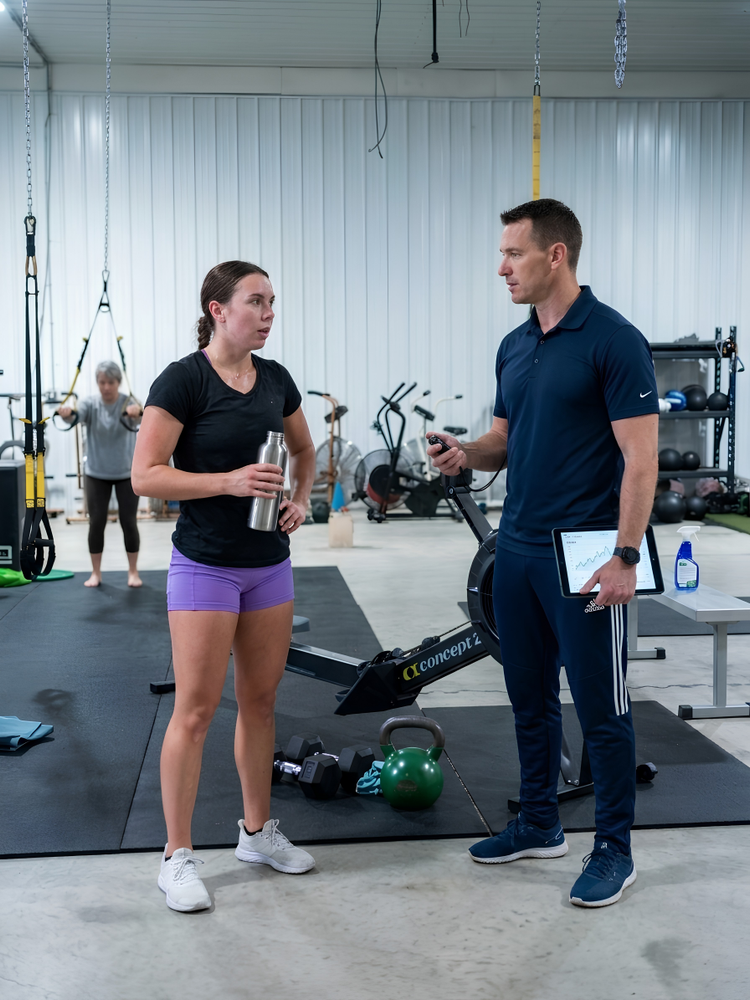
A good coach watches movement quality, performance, fatigue, and progression instead of simply asking you to work harder.
Through Small Group Training, you can benefit from the energy of training alongside other people while still having a coach adjust exercises and intensity to your ability.
That matters because two people can perform the same workout while requiring completely different modifications.
One may need more resistance.
Another may need additional recovery.
The goal is appropriate challenge, not identical suffering.
🧠 A Simple Framework for Building Endurance
If your goal is better stamina without constantly feeling exhausted, start here.
1. Build strength
Develop enough strength that everyday and conditioning movements require less of your maximum capacity.
2. Develop an aerobic foundation
Include sustainable conditioning that does not leave you destroyed.
3. Add intensity strategically
Use harder intervals when they serve a purpose rather than simply because they feel productive.
4. Progress gradually
Change one major variable at a time and monitor your response.
5. Protect recovery
Sleep, hydration, nutrition, and rest influence how much training you can actually absorb.
6. Measure performance
Track repeatable metrics instead of relying on sweat, soreness, or calorie estimates.
This framework is less exciting than chasing exhaustion every day.
It is also much more sustainable.
⚠️ Common Endurance Training Mistakes
Making every workout intense
When every session is hard, fatigue can hide your actual fitness.
Adding cardio without considering strength training
Strength can improve movement efficiency and increase your physical reserve.
Increasing volume too quickly
Your cardiovascular system may feel ready before your muscles and connective tissues are prepared for dramatically more work.
Ignoring technique when tired
Fatigue is not an excuse for poor movement. If technique consistently falls apart, the workout may be exceeding your current capacity.
Copying someone else's conditioning plan
Training volume should match your current fitness, goals, recovery, and schedule.
Treating rest as lost progress
Recovery is where adaptation occurs. More work is only useful when your body can recover from it.
❓ Frequently Asked Questions
How can I improve endurance without running every day?
Combine sustainable aerobic work with strength training and strategically programmed conditioning. Running can improve endurance, but it is not the only way to build cardiovascular and muscular stamina.
How many days per week should I train for endurance?
There is no universal number. Your ideal frequency depends on your experience, training intensity, recovery, goals, and other physical activity. For many recreational exercisers, several purposeful sessions each week are more sustainable than trying to train intensely every day.
Does strength training help cardiovascular endurance?
Strength training is not a replacement for cardiovascular training, but getting stronger can make repeated physical tasks more efficient. Combining strength and conditioning can produce more balanced fitness.
How do I know if I am doing too much cardio?
Look for trends rather than one bad day. Declining performance, persistent fatigue, poor recovery, disrupted sleep, and consistently heavy legs can indicate that your current workload needs adjustment.
Should beginners do high-intensity interval training?
Beginners can perform appropriately scaled intervals, but they do not need maximum intensity to improve. Building movement quality, basic strength, and aerobic capacity first often creates a better foundation.
How long does it take to improve endurance?
Some people notice improved workout tolerance within several weeks, but meaningful endurance development is an ongoing process. Your starting fitness, consistency, recovery, and training quality all affect the timeline.
🎯 Better Endurance Should Make You More Capable, Not More Exhausted
There is a simple test for whether your endurance program is working.
Over time, can you do more while feeling more capable?
That might mean running farther at the same effort, recovering faster between rounds, using heavier weights without losing pace, or finishing a workout feeling challenged instead of completely depleted.
That is progress.
You do not need to prove how tough you are every time you train.
You need enough challenge to create adaptation, enough structure to measure improvement, and enough recovery to repeat the process.
At Bare Fitness, Customized Fitness Programs can help take the guesswork out of balancing strength, conditioning, progression, and recovery.
The goal is not simply surviving harder workouts.
It is building a body that can handle more of what you want to do, both inside and outside the gym. 💪