Is 30 Minutes of Personal Training Enough? What Busy Adults Should Know
Oct 1, 2026
by Christopher windbigler
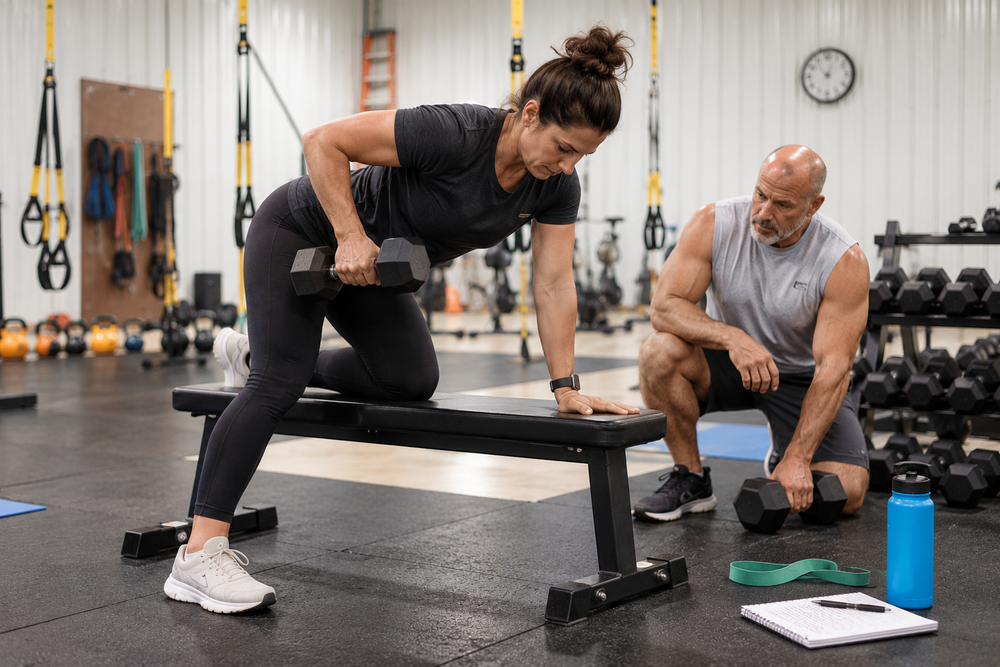
You want to get stronger and feel better, but finding an extra hour several times a week feels nearly impossible.
So, is a 30-minute personal training session actually worth it?
For many adults, yes. A focused 30-minute session can provide enough time for meaningful strength and fitness work when the exercises are selected carefully, the workout matches your goals, and your training progresses over time.
That does not mean 30 minutes is the perfect duration for everyone. It also does not mean a short workout replaces all the physical activity you need throughout the week.
The better question is this:
What do you need to accomplish during your training time?
At Bare Fitness in Elkhart, Personal Training includes both focused 30-minute sessions and comprehensive 60-minute sessions. Understanding the difference can help you choose an approach that fits your goals rather than assuming longer is automatically better.
Why Workout Length Does Not Tell the Whole Story
Spending more time in the gym does not automatically make a workout more productive.
Imagine two people.
The first spends an hour at the gym but has no clear plan. There are long breaks between exercises, frequent phone checks, and no system for tracking progress.
The second has 30 minutes with a coach. Exercises are prepared in advance, transitions are efficient, technique is monitored, and the resistance or repetitions are adjusted as the person improves.
The second workout is shorter, but every minute has a purpose.
This is where coaching and programming matter.
A productive workout should be judged by what it helps you accomplish over time, not simply by how long you remain inside the gym.
What Can Fit Into a 30 Minute Personal Training Session? ⏱️
Thirty minutes goes quickly, so exercise selection matters.
A hypothetical focused session might include:
Minutes 1 through 5: Specific movement preparation and warm-up
Minutes 6 through 15: Primary strength movements
Minutes 16 through 25: Complementary strength exercises, core work, or a focused training goal
Minutes 26 through 30: Mobility, brief conditioning, or a review of progress
The exact structure should depend on the person.
Someone learning a squat may need more coaching time.
Someone with established technique may be able to move efficiently between several exercises.
Someone working on a specific mobility or strength limitation may spend most of the session addressing that priority.
Bare Fitness describes its 30 Minute Focused Personal Training option as individualized coaching for busy adults, beginners, and clients working on specific strength, mobility, technique, or weight management goals.
That makes the shorter format particularly relevant when the goal is clearly defined.
What Does the Research Say About Shorter Workouts?
There is no rule stating that an effective workout must last 60 minutes.
Current physical activity guidance from the Centers for Disease Control and Prevention recommends that adults accumulate at least 150 minutes of moderate-intensity aerobic activity each week, or an equivalent amount of vigorous activity, along with muscle strengthening activity on at least two days each week.
Importantly, that activity does not need to happen in one continuous session.
The CDC notes that activity can be spread throughout the week and broken into smaller amounts.
Current guidance from the American College of Sports Medicine also emphasizes an important principle for resistance training: complicated programming is not automatically better. A routine that fits your schedule, abilities, and goals is valuable because consistency is fundamental to long-term progress.
In practical terms, a 30-minute personal training session can contribute meaningfully to your overall fitness plan.
It simply needs to be considered as part of the entire week rather than as an isolated workout.
When 30 Minutes Can Make a Lot of Sense
Shorter personal training can be particularly practical for several types of people.
Busy professionals
If your work schedule makes an hour difficult to protect consistently, a shorter appointment may be easier to maintain.
Parents and caregivers
Thirty minutes may fit between responsibilities more realistically than a longer gym visit.
Beginners
A focused session can provide time to learn a manageable number of exercises without making the first weeks of training unnecessarily complicated.
People returning to exercise
You may not need a huge amount of training volume immediately after a long break. A gradual approach gives you time to develop consistency and tolerance.
People with a specific training priority
If your goal is improving a particular movement, building strength in a specific area, or receiving technique coaching, a focused session can use time efficiently.
💡 The important word is focused. Thirty random minutes and 30 deliberately programmed minutes are not the same thing.
When a 60 Minute Session May Be More Appropriate
There are also situations where additional time is useful.
Bare Fitness describes its 60 Minute Comprehensive Personal Training as a customized session that can combine strength, conditioning, mobility, and accountability.
A longer session may therefore make more sense when you want to address several priorities during the same appointment.
For example, additional time can allow for:
- More total strength training
- Additional exercise instruction
- Longer conditioning work
- More extensive mobility work
- A greater number of movement patterns
- More time to practice unfamiliar exercises
- Specialized performance work
This does not make 60 minutes universally superior.
It simply provides more room.
The best choice depends on what needs to fit inside that room.
30 Minutes vs 60 Minutes: A Practical Comparison
| Consideration | 30 Minute Session | 60 Minute Session |
|---|---|---|
| Schedule | Easier to fit into a busy day | Requires a larger time block |
| Training focus | Works well for a defined priority | Allows several priorities in one session |
| Exercise instruction | Best with a focused selection | More time for teaching and practice |
| Strength work | Can support efficient resistance training | Allows more total training volume |
| Conditioning | May need to be brief or performed separately | More room for dedicated conditioning |
| Mobility | Can target specific needs | Allows more extensive mobility work |
| Best fit | Busy adults, beginners, focused goals | Broader or more complex training goals |
Neither column represents the better workout.
The right choice is the one that matches your needs and that you can perform consistently.
What Matters More Than Session Length?
If you are deciding whether shorter workouts are worthwhile, focus on these five factors.
1. Consistency
The program needs to fit your real schedule.
A 60-minute plan you regularly cancel is not automatically more useful than a shorter plan you can maintain.
2. Progressive challenge
Your body needs an appropriate reason to adapt.
Depending on your goal, progression could involve additional resistance, repetitions, improved movement control, or more challenging exercise variations.
3. Exercise selection
Short sessions leave little room for exercises that do not support your goal.
A coach can prioritize movements that give the session a clear purpose.
4. Technique
Rushing through exercises to fit more into 30 minutes defeats the purpose.
Efficiency should never mean sacrificing movement quality.
5. Your activity outside personal training
Your health does not depend entirely on what happens during a coaching session.
Walking, recreational activity, additional planned exercise, and general daily movement all contribute to your weekly physical activity.
A Simple Decision Checklist ✅
Not sure which session length makes sense?
Ask yourself these questions:
Do I regularly struggle to find an uninterrupted hour for exercise?
A focused 30-minute option may make consistency easier.
Do I have several goals that need attention during the same session?
A 60-minute session may provide more flexibility.
Am I new to exercise and need substantial instruction?
Either format may work, but the appropriate choice depends on how much coaching and practice you need.
Do I already perform other physical activity during the week?
Your personal training sessions should be considered alongside everything else you do.
Do I have a specialized athletic goal?
You may require additional training volume or a more specialized program.
Am I choosing a longer workout simply because it feels more legitimate?
Duration alone is not a measure of workout quality.
What About Fat Loss?
This deserves special attention because people often assume longer workouts automatically produce better fat loss results.
Body weight management is more complicated than the number of calories displayed on a fitness tracker.
Physical activity can support weight management, but nutrition, overall activity, individual energy needs, sleep, and long-term consistency also matter.
A 30-minute strength workout should not be turned into a frantic attempt to burn as many calories as possible.
If changing body composition is your goal, Nutrition Coaching and an appropriately structured training plan can address the broader habits that matter instead of asking one workout to do everything.
What About Small Group Training?
Personal training is not the only way to get coached exercise at Bare Fitness.
The business also offers Small Group Fitness and HIIT Classes, with coach-led workouts that are typically 45 minutes or less and can be scaled for different fitness levels.
This may appeal to someone who enjoys training alongside other people while still receiving coaching.
Personal training offers more individualized attention.
Small group training adds a stronger community component.
Your personality, goals, budget, and preferred training environment can all influence which option feels sustainable.
Frequently Asked Questions
Is 30 minutes enough to build strength?
Thirty minutes can provide enough time for productive resistance training, particularly when the workout is focused and appropriately programmed. Your weekly training frequency, exercise selection, effort, progression, nutrition, and recovery also influence results.
Is two 30-minute workouts per week enough?
Two sessions can provide a useful starting point and can contribute toward the recommendation to perform muscle strengthening activities on at least two days each week. However, your complete physical activity needs extend beyond strength training alone.
Should beginners choose 30 or 60 minutes?
There is no universal answer. Some beginners appreciate shorter, focused sessions. Others benefit from additional time to learn exercises, practice technique, and ask questions. Your starting ability and goals should guide the decision.
Is an hour always better than 30 minutes?
No. An hour provides more available training time, but workout effectiveness depends on programming, effort, progression, recovery, and consistency. More time is useful when there is a reason to use it.
Choose the Session That Fits Your Goal and Your Life
You do not need to earn the right to call something a workout by staying in the gym for an hour.
For many adults, 30 focused minutes can be a practical and productive way to train.
For others, 60 minutes creates the space needed for a broader combination of strength, conditioning, mobility, and coaching.
The key is matching the session to the person.
At Bare Fitness in Elkhart, Personal Training offers both focused 30-minute and comprehensive 60-minute options. Rather than choosing based on an arbitrary number, talk with the Bare Fitness team about your goals, current fitness level, schedule, and training experience.
The best training plan is not necessarily the longest one.
It is the one you can consistently use to move forward. 💪