Strength Training After 50: How to Start Safely and Build Lasting Strength
Oct 15, 2026
by Christopher windbigler
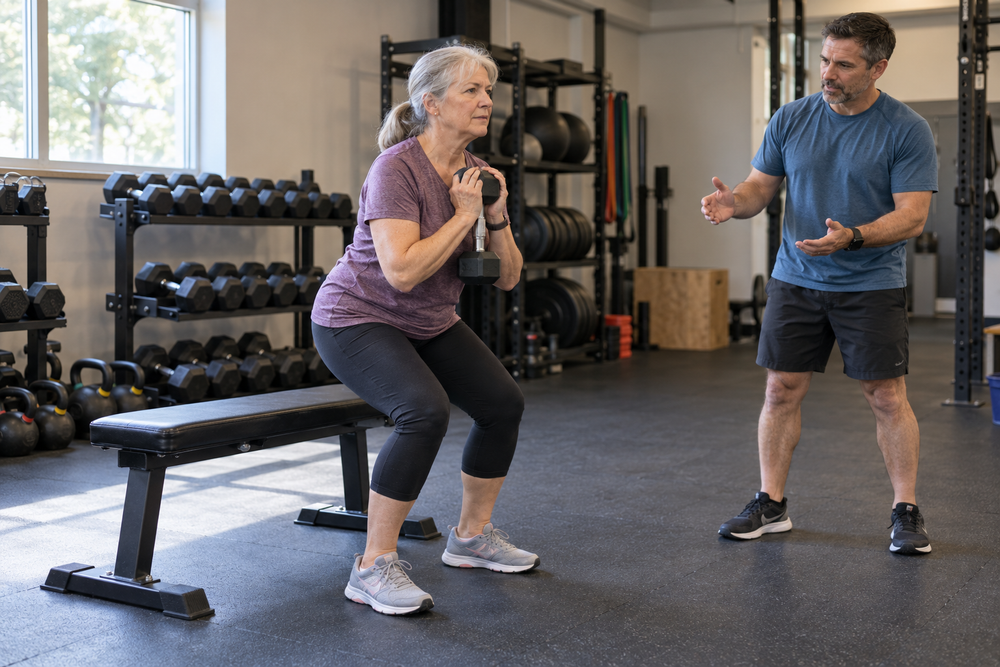
If you are in your 50s, 60s, or beyond and have not lifted weights in years, you may wonder whether strength training is still a good idea.
For most adults, getting older is not a reason to avoid resistance training. In fact, muscle strengthening activity becomes particularly valuable as you age. Current CDC guidance recommends muscle strengthening activity at least two days each week for adults, and adults age 65 and older should also incorporate aerobic and balance activities.
The key is not trying to train as you did at 25.
A smarter approach starts with your current abilities, builds good movement patterns, uses manageable resistance, and progresses gradually.
For adults in Elkhart who are unsure how to begin, individualized Personal Training can provide a structured starting point instead of leaving you to figure everything out on your own.
Why Strength Training Matters More as You Get Older
Aging is accompanied by changes in muscle mass, strength, balance, and physical function. Regular physical activity and structured exercise can help older adults maintain many of the physical abilities needed for everyday life.
That matters far beyond the gym.
Think about ordinary activities such as:
- Carrying groceries into your home
- Getting up from a low chair
- Moving something around the house
- Climbing stairs
- Picking something up from the floor
- Carrying luggage
- Enjoying outdoor activities
- Keeping up with children or grandchildren
Strength training is not simply about how much weight you can lift.
For many adults over 50, the more meaningful goal is maintaining the physical capacity to continue doing the things they enjoy.
💪 Strength for life is a different goal from strength for competition.
You Do Not Need to Start With Heavy Weights
One of the biggest misconceptions about resistance training is that it requires heavy barbells.
It does not.
Muscles can be challenged through dumbbells, resistance bands, kettlebells, bodyweight exercises, and other forms of resistance. CDC guidance includes weights, resistance bands, and body weight movements among examples of muscle strengthening activity.
If you are returning after a long period without structured exercise, the first goal should not be discovering the heaviest weight you can lift.
Start by learning how to perform the movement well.
Then add resistance gradually.
This approach is especially useful if movements such as squatting, pushing, pulling, carrying, or getting down toward the floor currently feel unfamiliar.
What Should a Beginner Strength Workout Include?
You do not need twenty different exercises.
A simple program can cover several fundamental movement patterns.
A lower body movement
A squat variation or sit-to-stand exercise can develop the muscles involved in standing, climbing, and many daily activities.
A pulling movement
Rows performed with an appropriate resistance can train muscles of the upper body and back.
A pushing movement
Depending on your ability, this might involve dumbbells, a machine, or a modified body weight exercise.
A hip-focused movement
Appropriately coached hinge movements can strengthen the hips and posterior muscles used in many lifting tasks.
Carrying or core work
Carries and other appropriate exercises can challenge trunk control and whole-body strength.
The exact exercises should match the individual rather than their age alone.
A healthy, experienced 60-year-old and a sedentary 60-year-old returning after years away from exercise may need very different programs.
Bare Fitness states that its Personal Training sessions are customized around current fitness level, goals, and lifestyle, with individualized workout planning and form coaching.
How Much Strength Training Do You Actually Need? ⏱️
You do not need to spend every day lifting weights.
CDC recommendations call for muscle strengthening activities on at least two days per week for adults, with activities addressing the major muscle groups. For adults age 65 and older, weekly activity should also include aerobic exercise and balance work.
That provides a useful starting framework, but your actual program should reflect your health, experience, schedule, and recovery.
Here is a hypothetical example for an active adult over 50 who has been cleared for exercise:
| Day | Activity |
|---|---|
| Monday | Full body strength training |
| Tuesday | Comfortable walk |
| Wednesday | Mobility and normal daily activity |
| Thursday | Full body strength training |
| Friday | Comfortable walk |
| Saturday | Recreational activity or light cardio |
| Sunday | Recovery and normal movement |
This is an example, not a prescription.
You may need more or less activity depending on your starting point.
Bare Fitness offers both 30 Minute Focused Personal Training and 60 Minute Comprehensive Personal Training, which means session length can also be selected according to the amount of coaching and training you need rather than assuming everyone requires the same format.
What About Balance?
Balance deserves more attention as you get older.
For adults 65 and older, CDC guidance specifically recommends balance activity in addition to aerobic and muscle strengthening exercise.
Balance training does not have to mean standing on unstable equipment while juggling weights.
It can begin with appropriately selected exercises that challenge your ability to control your body safely.
Depending on your ability, that might include supported balance work, controlled stepping patterns, or exercises that require maintaining stability while moving.
Strength and balance can also overlap. Stronger legs and trunk muscles support many everyday movements, although a complete program for older adults should not assume that strength work alone addresses every aspect of balance.
How Hard Should You Train?
A useful workout needs enough challenge to create adaptation, but that does not mean every set should be pushed to your limit.
If you are new or returning to strength training, focus first on:
- Learning the exercise
- Using a manageable resistance
- Maintaining control
- Completing repetitions with consistent technique
- Recovering adequately between sessions
- Increasing the challenge gradually
ACSM resources for older adults emphasize resistance training as an important part of maintaining strength and function and recommend incorporating strength alongside functional and balance exercises.
You do not need to prove how strong you are during your first month.
You are building a foundation for the months and years ahead.
Common Mistakes When Starting Strength Training After 50
Doing too much too soon
Feeling motivated is great.
Trying to make up for ten years without exercise in ten days is not.
Your muscles and your tolerance for training need time to adapt.
Choosing exercises because they look impressive
An exercise does not need to be complicated to be useful.
The appropriate movement is one you can perform effectively and progress according to your goals.
Ignoring recovery
Training is only part of the process.
Sleep, nutrition, hydration, and appropriate time between demanding sessions all contribute to your ability to train consistently.
Comparing yourself with your younger self
What you lifted decades ago is not the most useful benchmark.
Start with what your body can do now and build from there.
Avoiding resistance because you feel weak
You do not need to become strong before starting strength training.
Strength training is one of the tools you use to become stronger.
Your Before You Start Checklist ✅
Before beginning or substantially increasing your exercise program, consider the following:
What is my current activity level?
Be realistic about where you are starting.
Do I have pain or an unresolved injury?
Exercise should not be used to diagnose or independently rehabilitate an injury.
Do I have a medical condition that affects exercise?
Adults with chronic conditions should understand how their conditions may affect safe participation. CDC guidance specifically advises older adults to account for their abilities and health conditions when determining activity.
Do I know how to perform the exercises?
If not, this is where professional instruction can be particularly useful.
Is my program progressive?
Your training should have a way to become appropriately more challenging as your abilities improve.
Can I realistically maintain this schedule?
Two consistent sessions can be more useful than an ambitious schedule you abandon after two weeks.
How Personal Training Can Help
The weight itself is only one variable in a strength program.
Exercise selection, technique, repetitions, recovery, progression, mobility, and your individual starting point all matter.
That is where personalized coaching can be valuable.
Bare Fitness offers one-on-one personal training in Elkhart with individualized workout planning and form coaching. Its 30-minute option is specifically positioned for busy adults, beginners, and clients working on focused strength, mobility, or technique goals, while the 60-minute format allows more time for strength, conditioning, mobility, and accountability.
For someone who has not exercised consistently in years, that individualized structure can make the process less confusing.
Instead of asking, “What workout should someone my age do?”
You can start asking a better question:
“What training makes sense for me right now?”
Frequently Asked Questions
Is 50 too old to start lifting weights?
No. There is no general rule that says strength training should stop at 50. ACSM specifically identifies resistance training as valuable for older adults and emphasizes its role in maintaining strength and everyday function.
What if I have never lifted weights before?
You can still begin. Starting with manageable resistance, learning technique, and progressing gradually is more important than having previous gym experience.
How many days per week should adults over 50 strength train?
Current US guidelines recommend muscle strengthening activity on at least two days each week for adults. Your individual frequency can vary according to your health, experience, other activity, and recovery.
Should I do cardio too?
Yes. Strength training is one component of physical fitness. Adults should also perform aerobic activity, and adults age 65 and older should include balance activity as part of their weekly routine.
Can I strength train if I have arthritis, osteoporosis, heart disease, or another medical condition?
Possibly, but the appropriate program depends on your individual health and medical guidance. If you have a diagnosed condition, symptoms, significant pain, or concerns about exercise safety, speak with your healthcare professional before making substantial changes to your activity.
Stronger Can Mean More Capable
Strength training after 50 does not have to be about chasing personal records or trying to look like someone you follow online.
It can be about something much more practical.
Carrying your own groceries.
Getting up confidently.
Traveling.
Working in the yard.
Playing with your family.
Continuing to do the activities that make your life yours. 🌟
Start at your current level, learn the movements, progress gradually, and give consistency time to work.
If you want individualized guidance in Elkhart, Bare Fitness offers Personal Training with focused 30-minute and comprehensive 60-minute options designed around your current fitness level, goals, and lifestyle.
The goal is not to train like you are younger.
It is to build strength that helps you keep living well.